

Brilliant finance professional. Second time working with him and am really pleased with his quality of work as well as professionalism
- Oliver Theodore
Vice President
Healthcare integration is more than just transferring data between systems. The integration should get to know where information comes from, what it should become, where it should go and how it might fit into the real clinical and operational workflow.
We design integrations around how clinicians, patients, administrators, and operational teams actually use information.
We work with modern healthcare interoperability standards and existing healthcare environments to enable structured data exchange between systems.
We connect healthcare applications with electronic health record systems so relevant information can move more efficiently between products and workflows.
We consider architecture, APIs, data mapping, transformations, validation, monitoring, and future integration requirements.
We focus on data accuracy, consistency, error handling, traceability, and dependable information flows.
We make integration decisions based on the product experience and business workflow, not only the technical interface.
“The biggest improvement wasn't simply that our systems could exchange data. Information started appearing where our teams actually needed it, and we were able to eliminate several manual steps that had become part of the daily workflow.”
Brilliant finance professional. Second time working with him and am really pleased with his quality of work as well as professionalism
- Oliver Theodore
Vice President
Speecto connects healthcare products, platforms, data sources, and devices to create more unified clinical, patient, and operational experiences.
Connect healthcare applications with electronic health record systems to enable secure and efficient access to patient and clinical data.
Build standards based interfaces that allow healthcare systems to exchange clinical information accurately and securely.
Connect medical devices with healthcare platforms to capture, synchronize, and manage patient generated or clinical data.
Integrate video consultations, scheduling, patient communication, and other virtual care capabilities into healthcare products.
Connect healthcare applications with third-party platforms, services, and data sources through secure APIs.
Enable healthcare systems to exchange lab orders, diagnostic information, and test results with laboratories and diagnostic providers.
Connect patient-facing and provider facing systems to improve communication, data accessibility, and continuity of care.
Build secure solutions that allow clinical and operational data to move reliably between different healthcare systems and organizations.
These are the concerns we repeatedly hear from healthcare teams:
Our application needs EHR data, but every system seems to handle integration differently.
Our staff is entering the same information into multiple systems.
We have an HL7 interface, but maintaining and troubleshooting it has become difficult.
We need to support FHIR, but we're not sure how it should fit into our existing architecture.
Our device or telehealth data doesn't flow cleanly into the rest of the patient workflow.
When an integration fails, we don't have enough visibility into what went wrong.
.svg)
We build healthcare integrations that connect systems, standardize data exchange, and support more efficient workflows across digital health environments.
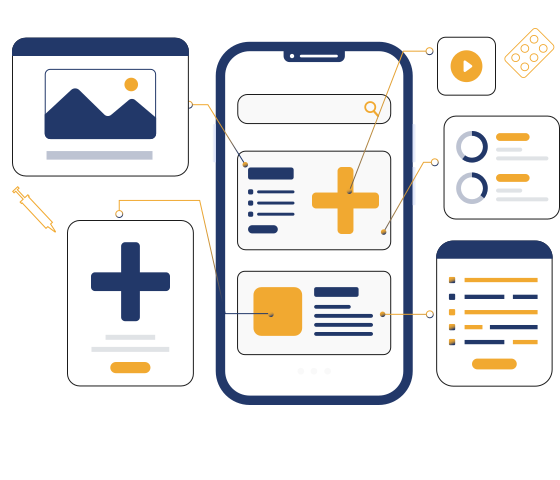
Connect digital health applications with electronic health record and electronic medical record systems to exchange patient, clinical, scheduling, and other relevant information.
How we turn ideas into solutions
We don't start by simply asking which API needs to connect to which platform. We first understand what information needs to move, who needs it, when they need it, and what should happen before and after the exchange. This prevents technically functional integrations from creating inefficient real world workflows.
We identify source and destination systems, available interfaces, data structures, dependencies, authentication requirements, supported standards, and expected information flows. From there, we define how data needs to be mapped, transformed, validated, and exchanged.
Not every healthcare environment operates on the same technology or interoperability standard. Depending on the systems involved, an integration may use FHIR APIs, HL7 interfaces, vendor APIs, custom APIs, webhooks, middleware, or a combination of approaches.
Healthcare data exchange cannot assume every request will succeed. We design integrations with appropriate validation, error handling, retry logic, logging, monitoring, and reconciliation processes so teams can identify and manage problems when they occur.
An integration isn't complete because two systems successfully exchanged a test message. We validate how information moves through the actual product workflow and verify that users receive the expected data at the right point in the process.
Healthcare products rarely stop at one integration. We consider future systems, additional data sources, new workflows, and evolving interoperability requirements so the architecture doesn't become increasingly difficult to maintain as the ecosystem grows.
AI is increasing the value of connected healthcare data and making fragmented systems an even bigger limitation.
An AI assistant, clinical search experience, automation workflow, or analytics platform can only work with the information it can reliably access. When relevant data is trapped across disconnected EHRs, applications, devices, documents, and operational systems, intelligent features have an incomplete view of the workflow.
Integration therefore becomes part of the foundation for healthcare AI.
Organizations need reliable ways to retrieve, normalize, exchange, and govern information across systems before advanced capabilities can consistently use it.
We approach healthcare integration with that future in mind, creating data and system connections that can support today's workflows while preparing products for analytics, automation, AI-powered experiences, and new digital health capabilities.
.svg)
We help healthcare organizations connect fragmented technologies and create more useful information flows across clinical, patient, and operational environments. Our expertise combines interoperability standards, API engineering, healthcare workflows, data architecture, system integration, and product development.
Connect healthcare products with EHR and EMR environments so appropriate clinical, patient, scheduling, and operational information can move between systems as part of a unified workflow.
Build interfaces for healthcare environments that rely on HL7 messaging. We handle mapping, transformations, validation, routing, and integration logic required to move information between participating systems.
Develop FHIR-based integrations and healthcare APIs that allow applications to exchange structured information using modern interoperability approaches.
Connect supported devices, applications, and data platforms so device-generated information can flow into digital health products and relevant clinical or operational workflows.
Integrate virtual care platforms and functionality with patient information, scheduling, documentation, communication, and other systems required to support connected telehealth experiences.
Bring information from multiple healthcare systems and data sources into more consistent, usable structures for applications, analytics, workflows, and other digital capabilities.
Design integration layers and architectures for healthcare products that need to communicate with multiple internal systems, external platforms, APIs, vendors, or data sources.
See how we help healthcare organizations solve complex product and technology challenges with practical, scalable solutions built around real clinical workflows.


Healthcare integration creates the most value when disconnected systems are creating additional work, limiting access to information, or preventing digital products from fitting naturally into existing workflows.
Allow healthcare applications to exchange relevant information with the systems clinicians and organizations already depend on.
Move information between connected systems so teams spend less time manually copying, uploading, or reconciling the same data.
Bring medical device and telehealth data into broader patient, clinical, and operational workflows instead of leaving it isolated in separate systems.
Build an integration architecture that can support additional applications, APIs, data sources, automation, analytics, and AI capabilities as your healthcare ecosystem grows.
Yes. We can work with healthcare environments using HL7 messaging as well as modern FHIR-based APIs. The appropriate approach depends on the systems, data, and workflows involved.